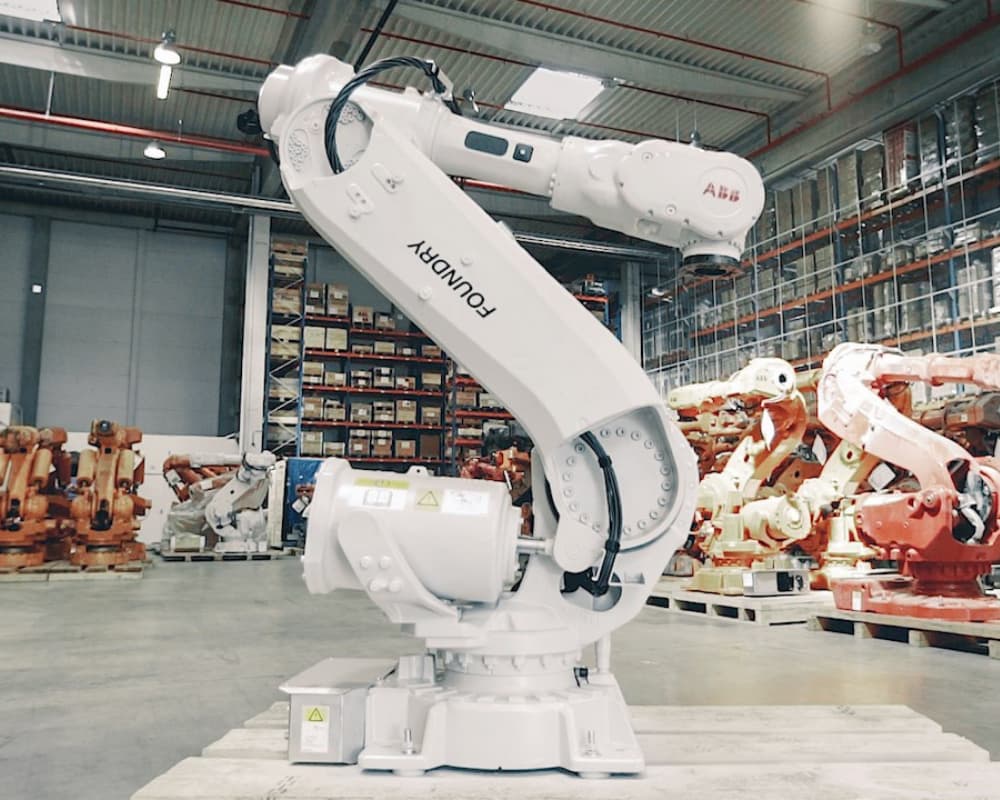
ABB Robotics and Nvidia have joined forces to enhance the way manufacturers design, test and deploy industrial robots, combining their simulation technologies to improve efficiency across factory operations.
The companies announced on Monday that Nvidia’s Omniverse libraries have been integrated into ABB Robotics’ existing design and simulation platform, RobotStudio. This integration enables physically realistic simulations with accuracy levels reaching up to 99%, allowing manufacturers to test robotic processes in virtual environments that closely mirror real-world conditions.
The collaboration aims to address the long-standing “sim-to-real” gap in robotics — the difference between simulated testing and actual performance on the factory floor. According to Marc Segura, manufacturers have struggled for decades to replicate complex variables such as shadows, textures and material behavior within simulation environments, limiting the pace of product development and research.
By leveraging Nvidia’s accelerated computing capabilities through the Nvidia Omniverse platform, developers will be able to train and test industrial robots more accurately before deploying them in real manufacturing settings.
“Instead of needing thousands of physical test runs, prototypes and expensive parts, robots can see, learn and understand inside a simulation that then translates perfectly into the real world,” Segura said during a press conference. “This enables matching precision between the virtual and physical environments.”
The upgraded software solution, called RobotStudio HyperReality, is expected to significantly streamline production preparation. The platform could eliminate the need for physical prototypes, reduce setup and commissioning time, and lower costs by as much as 40%. In addition, manufacturers may be able to bring complex products to market up to 50% faster.
Foxconn, the world’s largest electronics contract manufacturer, has already begun piloting the technology. The company is using the platform to virtually train assembly robots and identify ways to optimize its production lines.
Currently, more than 60,000 customers rely on ABB Robotics’ RobotStudio software. The new HyperReality version is expected to become commercially available in the second half of 2026.
“Precision is everything in consumer electronics manufacturing, and until now this level of accuracy and fidelity simply wasn’t possible in simulation and digital twins,” said Zhe Chi in a statement.
In recent years, Nvidia has built an expanding ecosystem of manufacturing partners leveraging its Omniverse platform to accelerate industrial automation and digital twin technologies. Companies collaborating with Nvidia include Hyundai Motor Group, Siemens and Samsung Electronics.
Earlier this month, Samsung Electronics unveiled a strategy to transform all of its manufacturing operations into AI-driven factories by 2030. The initiative includes the use of digital twin simulations, AI-powered workflow optimization and the deployment of humanoid and task-specific robots across production lines. The strategy was presented during Mobile World Congress 2026 in Barcelona, following an expansion of the company’s partnership with Nvidia.
“The next phase of manufacturing innovation lies in building autonomous environments where AI truly understands operational contexts in real time and independently executes optimal decisions,” said YoungSoo Lee.
Professional services firm Deloitte has also collaborated with Nvidia to develop physical AI solutions based on Omniverse libraries. According to a recent Deloitte survey, about 58% of companies already use physical AI technologies to some extent, and adoption is expected to reach nearly 80% within the next two years.