In the high-pressure environments of the global automotive industry, one color is synonymous with reliability, speed, and brute strength: KUKA Orange. Headquartered in Augsburg, Germany, KUKA (Keller und Knappich Augsburg) has been at the center of the industrial revolution since 1898. From building the first municipal lighting systems in Germany to inventing the world’s first industrial robot with six electromechanically driven axes in 1973 (the FAMULUS), KUKA has consistently defined the “Automotive Standard.”
Today, in 2026, KUKA remains the undisputed leader in high-payload applications and human-robot collaboration. With a massive global footprint and an ecosystem that bridges the gap between traditional heavy iron and high-tech digital operating systems like iiQKA.OS2, KUKA is not just a robot manufacturer it is the digital architect of the smart factory.
The Heavyweight Champion: KR FORTEC-ultra and the Power of 800kg
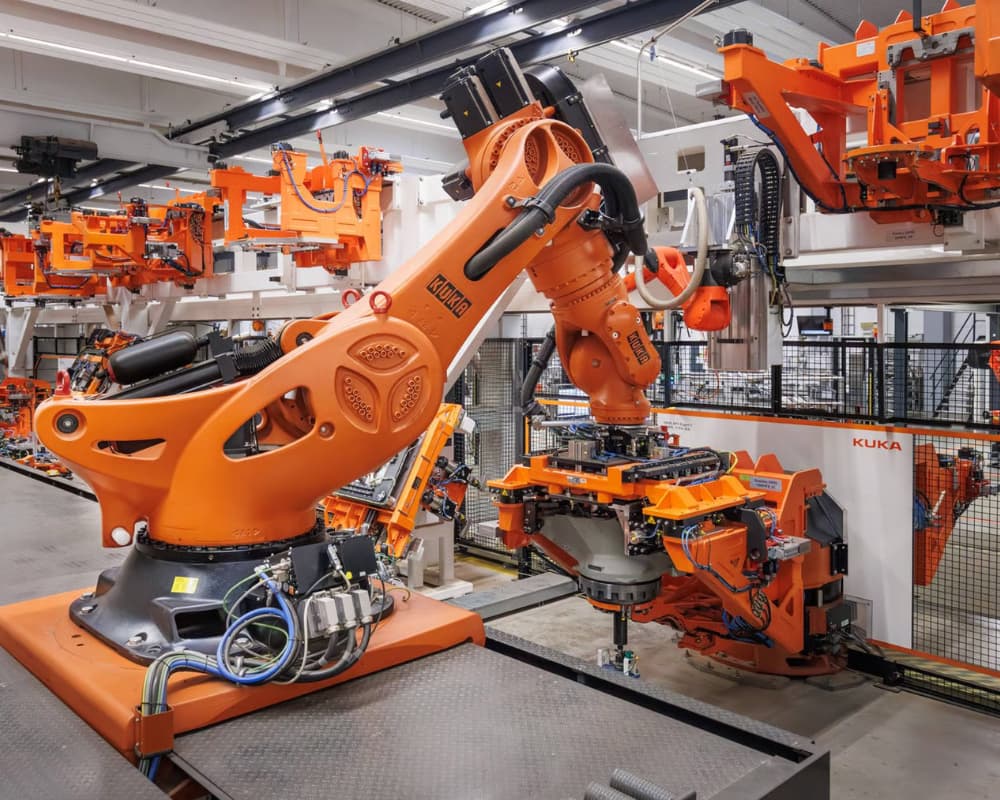
When a factory needs to move an entire electric vehicle (EV) battery pack, a heavy truck chassis, or a massive aerospace mold, it turns to KUKA’s Heavy-Payload division. The KR FORTEC-ultra series represents the pinnacle of this strength.
Engineering Mastery: The Double Rocker Design
The most striking feature of the new KR FORTEC-ultra is its innovative double rocker design. This mechanical architecture provides:
- Extreme Stiffness: Despite being up to 700kg lighter than its predecessors, the double rocker ensures that the robot maintains sub-millimeter precision even when swinging an 800kg load.
- Energy Efficiency: Lower weight means lower inertia, allowing the robot to accelerate faster while consuming significantly less power. In the ESG-conscious world of 2026, this directly translates to a lower carbon footprint for the factory.
- Dynamic Reach: With a reach of up to 3,700mm, these giants can cover vast work envelopes, often replacing the need for complex linear tracks.
The LBR Series: Sensitivity Meets Industrial Scale
While KUKA is famous for its “giants,” they are equally dominant in the world of “Sensitive Robotics.” The LBR (Leichtbauroboter – Lightweight Robot) series is the gold standard for human-robot collaboration (HRC).
LBR iiwa: The 7-Axis Pioneer
The LBR iiwa was the world’s first series-produced sensitive robot capable of working safely alongside humans.
- Torque Sensors in Every Joint: Unlike “power and force limiting” cobots that react after a collision, the LBR iiwa can “feel” its way around a workpiece with the sensitivity of a human hand.
- 7 Degrees of Freedom: The redundant seventh axis allows the robot to reach around obstacles in tight assembly spaces, a feature that is essential for modern electronics and medical device manufacturing.
LBR iisy: The Next-Gen Accessibility
By 2026, the LBR iisy series has expanded to include 11kg and 15kg variants. Designed for the “iiQKA” ecosystem, these cobots are ready for use in less than 90 minutes. They are built for the operator who wants the precision of a KUKA but the ease of a smartphone interface.
The Digital Pulse: iiQKA.OS2 and the Robotic Republic
KUKA’s most profound transformation in 2026 is its shift from a hardware-centric company to a software-defined robotics leader. The iiQKA.OS2 is the new universal operating system for all KUKA products.
Features of the 2026 Digital Ecosystem:
- Virtual Start-Up (VRC): Using the Virtual Robot Controller, engineers can simulate, program, and debug an entire production line before the physical robots even arrive. This reduces “Time-to-Market” by up to 50%.
- Cyber Resilience: iiQKA.OS2 is built on a Linux-based architecture that is IEC 62443 certified, ensuring that the “Smart Factory” is protected against the growing threat of industrial cyber-attacks.
- Robotic Republic: KUKA’s open ecosystem allows third-party developers to create “Apps” for robots, making it as easy to add a “Screwdriving App” or a “Vision App” to a robot as it is to download a game on a phone.
The Automotive Standard: Why OEMs Choose KUKA
KUKA is the “native language” of companies like Volkswagen, BMW, and Tesla. This dominance is built on the KR QUANTEC and KR FORTEC families, which offer the most comprehensive range of models in the industry.
- Standardization: KUKA’s modular design means that a factory can use the same motors, gear units, and castings across different robot families. This drastically reduces the cost of spare part storage.
- MTBF (Mean Time Before Failure): KUKA robots are engineered for a staggering 400,000 hours of operation. In a high-volume automotive line where one minute of downtime costs $20,000, KUKA’s reliability is the ultimate insurance policy.
- Foundry and Harsh Environments: KUKA’s “Foundry” and “Extreme” variants are built to withstand the heat of forge shops and the corrosive sprays of paint shops without losing accuracy.
LBR Med: Robotics in the Operating Room
KUKA is one of the few companies that has successfully transitioned heavy industrial technology into the life sciences. The LBR Med is the first cobot certified for integration into medical products.
- Biocompatible Surfaces: The robot’s paint and seals are resistant to medical disinfectants.
- Sub-millimeter Repeatability: Whether it is assisting in a spinal surgery or positioning a heavy X-ray head, the LBR Med provides the unwavering stability that a human surgeon requires.
Industry 4.0: iiQKA and Smart Production
In 2026, KUKA has moved beyond simple data collection to Predictive Action. Through the KUKA iiQKA platform, machines don’t just tell you they are broken; they tell you when they will break.
- Energy Monitoring: Every KUKA robot provides real-time data on its CO2 footprint per part produced, allowing companies to optimize their production schedules for the lowest energy cost.
- Remote Diagnostics: With “Three-Click Support,” a KUKA diagnostic file can be sent to Augsburg for immediate analysis, often resolving software issues before the operator even notices a performance drop.
Strategic Advantages: Why Choose KUKA?
For a global manufacturing director, KUKA represents a blend of “Old World” durability and “New World” intelligence.
| Performance Metric | KUKA 2026 Solution | Standard Competitors |
| Payload Capacity | Up to 1,500kg (KR TITAN). | Often limited to 600-800kg. |
| Operating System | iiQKA.OS2 (Linux/Cyber-resilient). | Proprietary/Closed systems. |
| Maintenance | 400,000 hour MTBF. | Standard 100,000-200,000 hours. |
| Modularity | Shared parts across 3 families. | Unique parts per model. |
| Simulation | Visual Components 5.0 (Digital Twin). | Basic 3D modeling. |
Sector-Specific Applications
KUKA technology is the backbone of the most complex production lines on Earth:
- E-Mobility: Assembling the massive battery trays for EVs using high-payload KR FORTEC-ultra robots for handling and KR CYBERTECH for precision dispensing of thermal paste.
- Consumer Electronics: Utilizing the high-speed KR AGILUS and LBR iisy for the delicate assembly of smartphones and wearables.
- Logistics: KUKA’s autonomous mobile robots (AMR) and palletizing giants work in harmony to automate the “last mile” of the warehouse.
- Aerospace: Drilling and riveting aircraft wings with high-accuracy robots that compensate for material deflection in real-time.
Training and the KUKA College
KUKA believes that the human is the center of the smart factory. The KUKA College network provides:
- Digital Learning: Virtual Reality (VR) training modules where operators can practice maintenance on a heavy-duty robot without any safety risks.
- Global Certification: Ensuring that a KUKA-certified technician in Turkey has the exact same skill set as one in Germany or China.
- STEM Outreach: Partnering with universities to provide the next generation of engineers with the tools to build a more automated world.
The “Green Robot” Initiative
By 2026, KUKA has implemented its “Resource-Saving Product” strategy across all lines.
- Material Reduction: The new KR FORTEC is 700kg lighter than its predecessor, using high-strength alloys that require less raw material to produce.
- Circular Economy: KUKA’s refurbishment program takes 20-year-old robots, updates their electronics, and returns them to the field with a new warranty, preventing thousands of tons of steel from entering landfills.
- Optimized Motion: AI-driven path planning ensures the robot takes the most energy-efficient route between points, not just the fastest.
The Future: AI-Driven Autonomous Fabrication
Looking toward 2030, KUKA is pioneering the “Self-Configuring Factory.” Using generative AI, a KUKA robot will soon be able to look at a 3D model of a new part and determine its own grippers, its own weld paths, and its own safety zones without a single line of human-written code. This is the promise of the iiQKA ecosystem.
The Definitive Choice for Industrial Excellence
KUKA remains the undisputed heavyweight champion of the robotic world. By staying true to their automotive standards of ruggedness while aggressively pursuing the digital future with iiQKA.OS2, they have provided manufacturers with a tool that is as intelligent as it is powerful.
For the company that demands 800kg of lifting power, surgical cobot sensitivity, and the world’s most advanced digital twin, KUKA is the only choice. They aren’t just building the orange robots that build cars; they are building the intelligent machines that build the modern world.
Experience the orange standard at www.kuka.com