In the highly competitive world of modern precision manufacturing, producers are in a relentless pursuit of faster, more cost-effective, and more capable production methods to tackle increasingly complex designs. At the heart of this evolution in fabrication technology lies 5-axis machining, a cornerstone of contemporary CNC machining trends. Once viewed as a premium technology reserved for specialized applications, multi-axis machines are rapidly moving toward becoming a standard necessity across virtually every industrial sector. This comprehensive article delves into the accelerated rise of 5-axis machining, the unique advantages it offers, and why it is universally recognized as the future foundation of modern manufacturing.
Understanding Multi-Axis Machining
The foundation of modern manufacturing—CNC (Computer Numerical Control) machining—has evolved in direct relation to the number of axes available for accessing the workpiece. An axis is an independent linear or rotational direction in which a cutting tool or workpiece can move. The term multi-axis machines refers to systems that go beyond the typical 3-axis setup, encompassing 4, 5, or more axes.
3-Axis vs. 5-Axis Comparison
Traditional 3-axis machining systems operate on three linear axes: $X$, $Y$, and $Z$. This means the tool can only move up/down, forward/backward, and left/right. For parts with complex geometries, 3-axis machines necessitate multiple manual repositioning (fixturing) of the workpiece by the operator, leading to interruptions in the process.
In contrast, 5-axis machining systems incorporate the three linear axes plus two rotary axes, typically designated as $A$ and $C$, or $B$ and $C$ (tilt and rotation). These additional rotary movements allow the cutting tool or the workpiece to be positioned at virtually any compound angle. This grants access to five sides of the part in a single clamping setup, dramatically increasing the capability of the machine.
Applications and Advantages
5-axis machining has revolutionized the production of parts featuring complex contours, sculpted surfaces, and deep cavities. Initially limited to niche fields like aerospace turbine blades or mold making, this advanced machining technology is now broadly used across a spectrum of applications, from medical implants to intricate automotive components.
A core benefit of 5-axis systems is the ability to maintain an optimal tool-to-workpiece angle at all times, which permits the use of shorter, more rigid cutting tools. This significantly reduces tool vibration and enhances the cutting process, resulting in superior surface finish and higher material removal rates. Furthermore, the capacity to machine the entire geometry in a single setup ensures consistency in part quality while substantially reducing the potential for accumulated fixture-related errors.
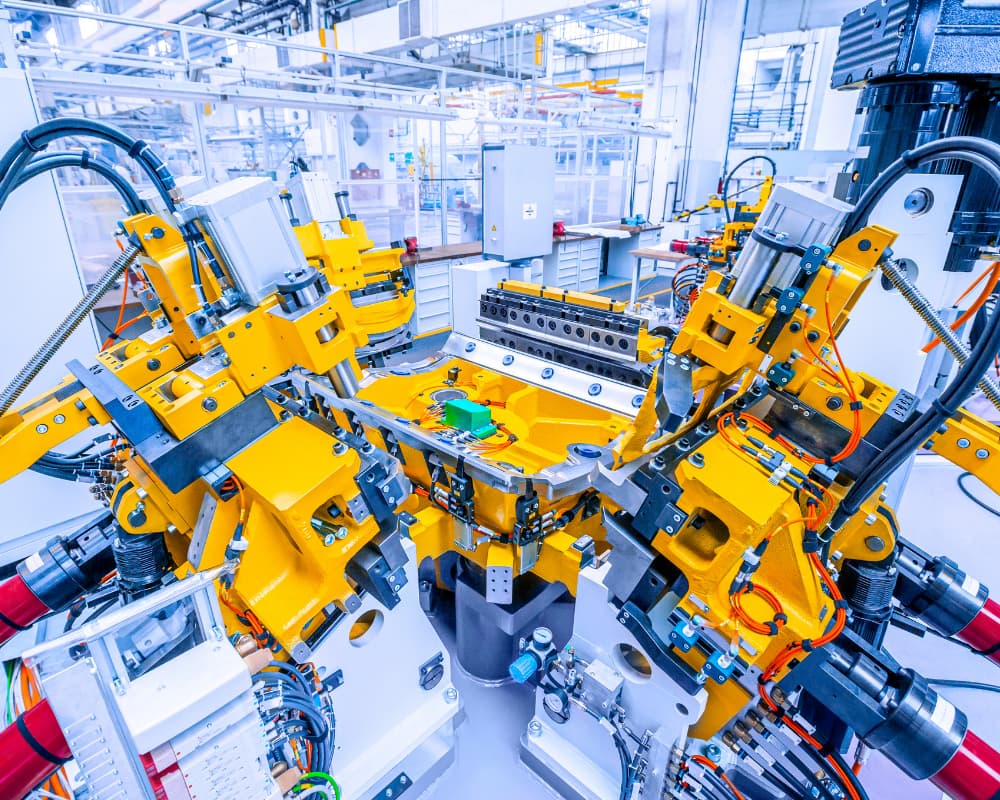
Benefits of 5-Axis Machines
The benefits offered by 5-axis machining systems extend far beyond simply accelerating production; they fundamentally enhance manufacturing quality, efficiency, and the final cost of the finished component.
Increased Precision and Complexity
5-axis machining has become an indispensable tool for achieving true precision manufacturing. Because the tool can approach the part from the ideal angle, smoother surface finishes and tighter geometric tolerances are attained, especially on curved and free-form surfaces. The elimination of multiple setups removes the accumulated tolerance losses that arise from re-fixturing the part. This is critically important in sectors like aerospace and medical devices, where modern advanced machining technology is a prerequisite for success. Complex parts can be manufactured with fewer steps and with higher accuracy.
Reduced Setup Time and Labor
To machine a part effectively on a 3-axis machine, it often needs to be re-fixtured multiple times to access different features. Each re-fixture introduces time-consuming setup procedures and carries an associated labor cost for manual intervention. With 5-axis machining, even highly complex parts can typically be completed in a single setup. This “Done-in-One” capability dramatically shortens the overall production cycle time. The reduction in setup times and labor costs plays a key role in boosting a business’s overall efficiency and competitive edge.
Industries Adopting 5-Axis Machining
The compelling advantages of multi-axis machines have made the technology attractive to a vast range of industrial sectors.
Aerospace and Automotive
The aerospace and automotive sectors were two of the earliest and most steadfast adopters of 5-axis machining. In aerospace, complex, aerodynamically optimized parts—such as turbine engine components, blisks (bladed disks), and structural components—made from high-strength materials are essential. 5-axis machining is the only viable method for producing these parts with the extreme precision manufacturing necessary to meet strict performance and lightweighting requirements.
In the automotive sector, 5-axis machining is utilized for the production of critical components like engine blocks, cylinder heads, and stamping dies. Demand for lightweight, complex-geometry parts is increasing, particularly for electric and high-performance vehicles, intensifying reliance on this technology.
Medical Device and Tooling Applications
The medical device industry benefits immensely from 5-axis machining due to its unique demands. Parts such as hip and knee implants, surgical instruments, and dental prosthetics must feature highly complex, contoured, and bio-compatible surfaces to ensure integration with the human body. 5-axis machining allows these highly customized and precision manufacturing parts to be produced efficiently.
In tooling and mold-making, the deep cavities, sloped surfaces, and complex parting lines required for plastic injection molds and casting dies are difficult or impossible to achieve with conventional methods. 5-axis machining enables high-accuracy machining of mold surfaces with fewer tools and in a single setup, driving down the final mold cost and delivery time.
As the adoption of 5-axis machining technology expands, machine and software manufacturers are continuously introducing innovations.
Hybrid and AI-Assisted Multi-Axis Systems
A burgeoning trend in the industry is the development of hybrid systems that combine 5-axis machining with other manufacturing technologies. For instance, systems integrating subtractive machining (milling) with metal additive manufacturing (3D printing) in a single machine allow for a part’s complex internal structure to be built additively, while its external surfaces requiring high precision manufacturing are finished with 5-axis milling.
Furthermore, Artificial Intelligence (AI) and Machine Learning (ML) algorithms are starting to optimize multi-axis machines operations. These systems monitor cutting forces, vibration, and tool wear in real-time, dynamically adjusting cutting parameters. This results in more efficient material removal rates, longer tool life, and ultimately, more consistent part quality.
Toolpath Optimization and Simulation
The inherent complexity of 5-axis machining makes accurate toolpath programming crucial. Today’s advanced CAM (Computer-Aided Manufacturing) software is equipped with collision avoidance algorithms and automated axis tilting strategies. These programs optimize toolpaths, smoothing machine movements, shortening cycle times, and virtually simulating potential machine and tool collisions to prevent them. These advanced simulation capabilities ease risk management, especially when machining high-value parts, and improve the “First-Time-Right” production rate.
The rise of 5-axis machining is no longer a trend; it is rapidly becoming an industrial mandate.
5-Axis as Industry Standard
As part geometries continue to increase in complexity, and as global competition demands tighter tolerances and shorter delivery times, the displacement of 3-axis machines by 5-axis machining as the industry standard is inevitable. Even small job shops are finding they must invest in this advanced machining technology to remain competitive. With decreasing costs and increasing ease of use, 5-axis machining is now a fundamental manufacturing capability, not a luxury.
Integration with Smart Factory Technologies
In the future, 5-axis machining systems will be fully integrated into the concepts of Industry 4.0 and the Smart Factory. Machines will continuously collect data via IoT (Internet of Things) sensors, sharing this information with centralized management systems to autonomously optimize production processes. Fully integrated and automated 5-axis machining cells will be capable of producing parts of high complexity and quality with minimal human intervention. This integration will lift the flexibility, efficiency, and scalability of manufacturing to a new echelon.
The unparalleled precision, speed, and single-setup capability offered by 5-axis machining have fundamentally reshaped modern manufacturing. This multi-axis machines technology is no longer merely an option for producing complex parts, but a required investment for any business seeking to maintain a competitive lead in the global race for precision manufacturing.