Industrial automation and the integration of robotics in manufacturing are defining characteristics of the Fourth Industrial Revolution, fundamentally changing how goods are produced globally. By leveraging advanced control systems and intelligent machines, manufacturers are achieving unprecedented levels of efficiency, precision, and safety. This comprehensive look explains the mechanics of modern industrial automation systems, details the diverse applications of industrial robots and cobots, and explores the transition toward the highly connected and adaptive ecosystem of the smart factory.

Understanding Industrial Automation
From Manual Processes to Automation
Industrial automation is the use of control systems, instrumentation, and technology to operate machinery and processes automatically, minimizing human intervention. This evolution began with mechanical devices and has progressed through electrical and electronic controls, culminating in the integrated digital systems of today. The shift from purely manual or semi-automated processes to fully automated systems is driven by the necessity for consistency, speed, and the elimination of human error, particularly in high-volume or hazardous environments. Modern industrial automation aims not only to replace human labor but also to perform tasks that human workers cannot, such as precise movements at high speeds or continuous monitoring of complex parameters.
Key Components of Automated Systems
A robust industrial automation system is composed of several critical, interconnected layers, working in harmony to monitor and control production. The foundation rests on sensors, which are the “eyes and ears” of the system, collecting real-time data on parameters like temperature, pressure, proximity, and machine condition. This data is fed to the controllers, often PLC systems (Programmable Logic Controllers), which serve as the system’s brain. PLCs process the input data according to a programmed logic and issue command signals.
These commands are then executed by actuators, which are the “muscles” that convert electrical or pneumatic signals into physical action, such as turning motors, opening valves, or moving robotic arms. All of these components are linked by robust industrial communication networks, and the entire system is overseen by the Human-Machine Interface (HMI), which provides operators with a visual dashboard for real-time data and diagnostics.
The Role of Robotics
Robotics in manufacturing has expanded dramatically, offering dynamic solutions for everything from heavy-duty assembly to delicate component handling.
Types of Industrial Robots
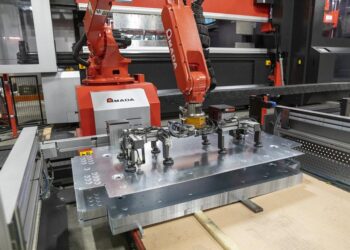
Industrial robots are the most recognizable form of automation, built for strength, speed, and precision in repetitive tasks. They typically operate behind safety barriers due to their power and high operational velocity. The field includes several distinct types, each suited for specific tasks: Articulated Robots (mimicking the human arm with multiple rotary joints, ideal for welding and painting); SCARA Robots (known for high speed in selective compliance assembly, perfect for pick-and-place); Delta Robots (used for high-speed sorting and packaging due to their parallel arm structure); and Cartesian Robots (operating on linear axes, often found in CNC machining). Their ability to work tirelessly and with unwavering accuracy makes them essential for mass production environments.
Collaborative Robots (Cobots)
A key development in modern robotics in manufacturing is the collaborative robot (cobots). Unlike their traditional counterparts, cobots are designed to facilitate human-robot collaboration by sharing the same physical workspace without the need for safety cages. Cobots are generally smaller, lighter, and equipped with sensitive force-torque sensors and internal safety protocols that allow them to slow down or stop upon contact with a human worker. This design makes them highly accessible and flexible, particularly for small factory automation and tasks where the machine needs to assist a worker or perform tasks that vary frequently, such as machine tending or intricate assembly steps.
Smart Factories and Connectivity
The move toward the smart factory is predicated on deep connectivity and the intelligent use of data, moving beyond simple programmed automation.
Industrial IoT Integration
The smart factory operates as a unified, integrated system thanks to Industrial IoT (IIoT) Integration. This involves networking all machines, sensors, robots, and enterprise software (ERP, MES) together. The IIoT provides the foundational nervous system, allowing machines to communicate not just with the central controller, but with each other. This constant stream of real-time data creates transparent operations, enabling managers to track every unit, monitor machine performance, and instantly identify bottlenecks or quality deviations across the entire production floor.
Real-Time Data and Predictive Systems
The immense volume of real-time data collected via the IIoT is the fuel for sophisticated predictive systems. Machine learning and AI algorithms analyze these data streams to look for anomalies and patterns indicative of future problems, such as bearing wear or tool breakage. This enables predictive maintenance, where the system automatically forecasts when a machine will fail, allowing maintenance to be scheduled proactively before an actual breakdown occurs. These intelligent predictive systems maximize uptime, optimize resource allocation, and ensure continuous industrial automation flow.
Automation in Production Lines
The combination of sophisticated robotics in manufacturing and intelligent control systems has transformed the efficiency and capability of core production tasks.
Assembly, Packaging, and Material Handling
Industrial automation is most visible in its core applications. In Assembly, robots perform highly repetitive and precise tasks, such as fitting micro-components in electronics or tightening bolts in the automotive sector, guaranteeing consistent quality. Packaging lines utilize high-speed Delta Robots for fast sorting and placing items into containers, increasing throughput dramatically. Material Handling is optimized through the use of Automated Guided Vehicles (AGVs) and Autonomous Mobile Robots (AMRs), which use smart navigation and real-time data to transport raw materials and finished goods across the factory floor, minimizing manual labor and logistical bottlenecks.
AI and Machine Vision in Robotics
The next level of robotics in manufacturing utilizes the power of AI and Machine Vision in Robotics. AI algorithms enable robots to interpret complex visual data from cameras and sensors, granting them “sight.” This capability allows robots to perform high-precision quality control, detecting microscopic surface defects or misaligned parts faster and more consistently than human inspectors. Furthermore, AI-powered vision systems enable robots to handle unstructured environments, such as performing random bin picking—locating and selecting randomly oriented parts from a bin—a complex task that was previously impossible for fixed industrial robots.
Future Outlook
The future of industrial automation is not one of complete human displacement, but rather one of deep, symbiotic integration and ethical responsibility.
Human-Robot Collaboration
The core trajectory for the coming decade is an evolution toward a deeper level of human-robot collaboration. This means more than just safety; it means creating seamless workflows where humans and cobots share tasks simultaneously, leveraging human creativity and judgment alongside robotic strength and precision. Technologies like Augmented Reality (AR) will allow human workers to guide and program industrial robots intuitively, enhancing their skills and transforming their roles into high-value supervisory positions focused on oversight and innovation.
The Move Toward Industry 5.0
The increasing focus on human-robot collaboration and sustainability signals The Move Toward Industry 5.0. While Industry 4.0 prioritized technological efficiency and smart factory goals, Industry 5.0 adds the pillars of human-centricity, resilience, and environmental sustainability. Future industrial automation systems will not only be efficient but also designed to maximize resource utilization and minimize waste, ensuring that technological advancement serves both economic goals and societal well-being. This shift mandates that all robotics in manufacturing and industrial automation solutions contribute to a more robust, responsible, and adaptable global production ecosystem.