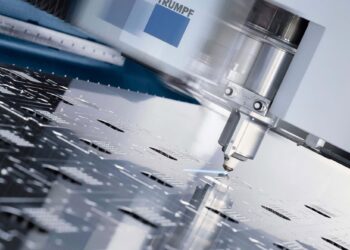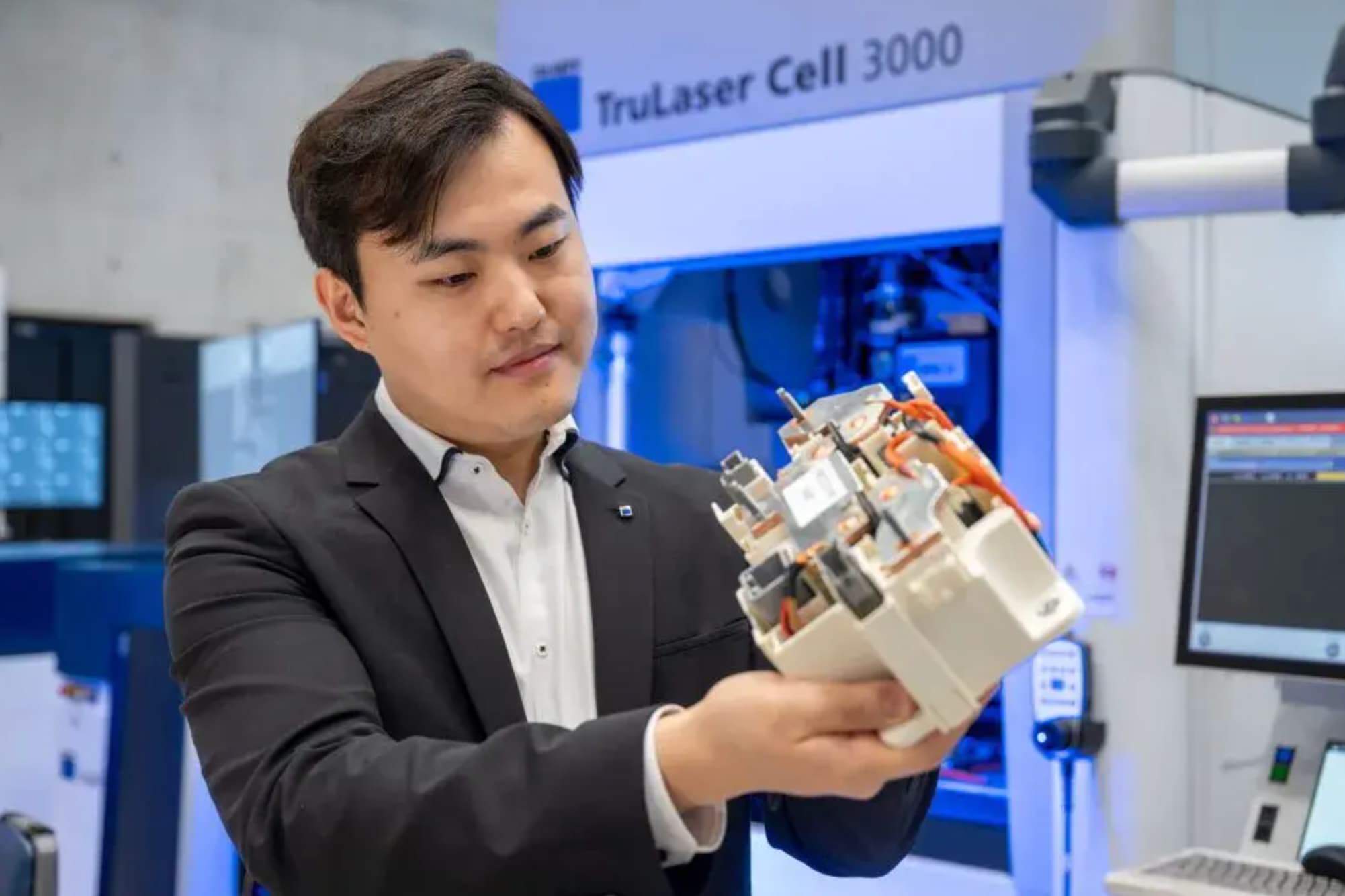
Trumpf has introduced a new laser welding solution designed to make the production of power electronics for electric and plug-in hybrid vehicles more efficient and reliable. The highly automated process welds copper electrical conductors directly onto copper busbars, enabling manufacturers to replace conventional screw connections in voltage distributors. The solution targets high-volume series production in the automotive sector, where robust, low-resistance connections are critical to performance and cost.
Trumpf’s new system combines a 9kW fibre laser, advanced sensor technology, AI-supported image processing and in-line quality monitoring in a single welding station. An AI-based vision system first identifies the component and positions the laser beam with pixel-level precision on the copper conductors. The 9kW fibre laser then welds the copper strands to the copper busbar, while an optical coherence tomography (OCT) module monitors weld depth in real time to prevent burn-through and ensure consistent penetration across varying cross-sections.
By replacing multi-step mechanical screw connections, the process is designed to reduce assembly time, lower the risk of human error and improve process stability in EV power electronics production lines. Screw joints in voltage distributors are susceptible to vibration, can loosen over time and typically exhibit higher electrical resistance, leading to energy losses and unwanted heat generation. In contrast, the laser-welded joints create a firmly fused copper-to-copper connection with low electrical resistance, which enhances overall powertrain efficiency and thermal behavior in the vehicle’s high-voltage system.
All key process stages—from component recognition through welding to post-process inspection—run fully automatically within a single laser cell. After welding, a second camera-based system evaluates the weld seam, again using AI to classify seam quality; according to Trumpf, only a small number of training images are required to achieve reliable assessments. Component recognition and beam positioning occur within milliseconds, and the complete weld sequence is completed in well under 1 second, making the solution suitable for high-throughput series production environments. For larger copper cross-sections, users can scale the process by deploying more powerful Trumpf lasers while maintaining the same automated workflow.
The development comes as OEMs and tier suppliers in the electric mobility sector face mounting pressure to reduce costs, increase energy efficiency and harden power electronics against vibration and thermal stress. Voltage distributors are present in every electric vehicle, routing high voltage from the traction battery to the electric motor, lighting and auxiliary loads, making connection technology a key lever for performance and warranty risk. As automakers ramp up EV volumes, highly automated laser processes that combine AI, inline monitoring and fast cycle times are becoming a strategic investment area for production engineering teams.
For manufacturers of power electronics and high-voltage components, Trumpf’s laser-based copper welding solution offers a pathway to shorten assembly cycles, improve connection reliability and reduce electrical losses in EV platforms. As more automotive plants modernize their joining technologies, integrated laser cells with embedded AI and real-time process control are likely to become standard equipment on next-generation e-mobility production lines.