The fusion of digitalization in manufacturing and Artificial Intelligence (AI) is the driving force behind the transformation of traditional plants into the smart factory of the future. By moving beyond simple automation to deep, data-driven intelligence, this synergy unlocks unparalleled efficiency, flexibility, and productivity. This comprehensive shift, characterized by interconnected systems and predictive analytics, is reshaping every aspect of industrial operations, from the design process to the final delivery.
Understanding Digitalization in Industry
Digitalization in manufacturing is the process of integrating digital technologies and digitized data into every area of a business, fundamentally changing how operations are performed and value is delivered.
Industry 4.0 vs. Industry 5.0
The current landscape is defined by two major phases of industrial evolution:
- Industry 4.0 : This phase focused primarily on cyber-physical systems (CPS), connecting machines, sensors, and IT systems via the Industrial Internet of Things (IIoT). Its core goal was horizontal and vertical integration to achieve maximum efficiency and automation. It centered on technology as the primary driver of optimization.
- Industry 5.0 : This emerging phase builds upon the technological foundation of Industry 4.0 but adds three new, human-centric pillars: sustainability, resilience, and human-centricity. It shifts the focus from efficiency alone to creating value by fostering human-AI collaboration, ensuring ethical production, and building supply chains robust enough to withstand global shocks.

Key Digital Technologies in Factories
The foundation of the digitalization in manufacturing factory rests on a few core technologies that enable the seamless flow of data:
- Industrial Internet of Things (IIoT): The network of interconnected sensors and devices that gathers operational data in real-time.
- Cloud Computing: Provides the vast, scalable infrastructure for storing and processing immense volumes of Big Data.
- Digital Twins: Virtual replicas of physical assets, processes, or entire factories used for simulation, testing, and predictive analytics before changes are implemented in the real world.
- Artificial Intelligence (AI): The analytical intelligence that processes the data, identifies patterns, and automates cognitive functions like prediction and decision-making.
AI Applications in Manufacturing
The true power of digitalization in manufacturing is realized when the torrent of IIoT data is processed by sophisticated AI in industry algorithms. AI transforms passive data into active intelligence.
Predictive Maintenance
One of the most cost-saving applications of AI in industry is predictive maintenance. Traditional preventive maintenance is time-based, often leading to premature parts replacement. AI systems, by analyzing real-time data from vibration, temperature, and current sensors, learn the normal operating “fingerprint” of a machine. They can then detect minute deviations from this baseline that signal impending failure, allowing maintenance to be scheduled precisely at the optimal moment, just before a breakdown occurs. This approach maximizes equipment uptime by extending the life of components while eliminating the massive costs associated with unplanned downtime and emergency repairs.
Process Optimization and Automation
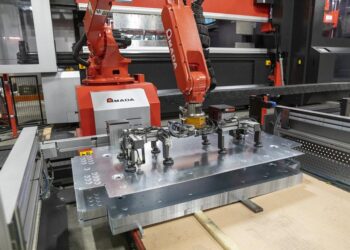
AI is used to fine-tune complex production variables beyond human capability. In continuous processes, machine learning models analyze parameters like temperature, pressure, flow rates, and material characteristics simultaneously, automatically making real-time adjustments to maximize yield and minimize energy consumption. Furthermore, AI in industry powers advanced factory automation through robotic systems that use computer vision and deep learning to handle complex, non-repetitive tasks, such as high-speed quality inspection or precise object manipulation in mixed product batches, thereby significantly increasing operational throughput and consistency.
Data Integration and Smart Systems
The intelligence provided by AI depends entirely on the quality and accessibility of data collected by the vast network of industrial IoT devices.
Industrial IoT and Cloud Platforms
The industrial IoT provides the sensory layer, acting as the eyes and ears of the smart factory. Thousands of sensors embedded in machinery, tools, and materials collect data streams at high velocity. These streams are aggregated and transmitted to cloud platforms, which offer the necessary computational muscle for running complex AI models, particularly for training algorithms and performing deep, historical analysis. The cloud platform acts as the central brain, providing a unified, integrated view of all factory operations and the entire supply chain, which is critical for holistic process management.
Edge Computing and Real-Time Insights
While the cloud handles macro-level analysis, edge computing addresses the need for instantaneous response. Edge devices are compact computing units installed directly on the factory floor, near the machines. These devices process sensor data locally, enabling sub-millisecond decision-making, such as collision avoidance, immediate quality checks, or instantaneous parameter adjustments. This decentralized processing capability ensures the factory can operate effectively even with intermittent cloud connectivity, delivering robust real-time insights and low-latency control essential for sensitive operations.
Benefits of AI-Powered Factories
The synergy created by digitalization in manufacturing and AI in industry translates directly into profound and measurable competitive advantages.
Increased Efficiency and Productivity
AI-driven systems continuously optimize every aspect of production, from material handling routes to machine parameters. By eliminating bottlenecks and ensuring assets run at peak performance (as measured by Overall Equipment Effectiveness, or OEE), factories achieve substantial increases in efficiency and productivity. Machines run faster, stop less often, and produce fewer defective parts, maximizing the value extracted from every hour of operation and capital investment.
Cost Reduction and Waste Minimization
Digitalization in manufacturing directly addresses major cost centers. Predictive analytics significantly reduce maintenance costs by replacing parts only when necessary. AI-powered quality control systems, utilizing advanced computer vision, catch defects earlier than human inspectors, reducing scrap and waste minimization. Furthermore, AI optimizes energy usage by dynamically adjusting loads based on production schedules and tariffs, leading to substantial reductions in utility expenses and promoting industrial sustainability.
Future Outlook
The trajectory of the smart factory is accelerating, moving toward environments that are not only efficient but also highly resilient and adaptive.
Human-AI Collaboration in Production
The future will see a deeper human-AI collaboration in production. Unlike early automation fears, Industry 5.0 emphasizes AI’s role in augmenting human capabilities. Workers will utilize Augmented Reality (AR) headsets guided by AI to perform complex maintenance or assembly tasks with higher precision. Collaborative robots (cobots), powered by AI vision systems, will safely work alongside humans, handling strenuous or repetitive tasks while humans focus on creative problem-solving, quality oversight, and complex customization tasks.
Emerging Technologies Shaping the Factory
The continuing evolution of the smart factory will be shaped by several emerging technologies:
- Generative AI will be used to design new products and optimize production lines in a fraction of the time, creating highly efficient and manufacturable designs.
- Blockchain technology will enhance supply chain transparency, providing immutable records of material origin and process compliance, crucial for ethical sourcing and compliance.
- More powerful edge computing devices, capable of running complex deep learning models locally, will enable full autonomy for specialized machinery and production cells, further defining the age of smart manufacturing.