EVS Metal reached $97 million in revenue for 2025. The New Jersey-based contract fabricator attributes much of that growth to automated turret punch presses. These machines handle production blanking across four U.S. facilities. The strategy centers on balancing material yield with downstream forming requirements.
Joe Amico, vice president at EVS Metal, has operated turret punches since the company’s founding in the 1990s. Today, he oversees a fleet of AMADA machines equipped with tower automation. The configuration enables lights-out operation for high-mix production work.
High-Mix Production Demands Flexible Blanking
Contract fabricators face a fundamental challenge. They must process diverse part geometries without sacrificing throughput. EVS Metal’s product mix illustrates this complexity. The company’s largest customer accounts for less than 11% of total revenue. More than 70% of customers contribute no more than 4% each.
Point-of-purchase kiosks represent just 14% of revenue despite involving numerous sheet metal components. Each kiosk is essentially built to order. This pattern repeats across data center enclosures, ventilation panels, and electronic component housings.
Static nests on the turret punches address this variety. Programmers place parts from multiple jobs on single sheets. Part orientation minimizes turret indexing time. Common-line punching reduces material waste. Parts for specific assemblies stay grouped for faster downstream kit flow.
Tool Magazine Automation Expands Part Families
The AMADA ZRTe turret punch models feature magazines holding more than 100 tools. Mechanized arms transfer tools between the magazine and a buffer turret. QR codes on each tool track hits between sharpening cycles. This automation broadens the product families a single machine can process unattended.
Amico noted the practical impact. Multiple jobs can run overnight without operator intervention. Tool breakage rarely interrupts production because dies ride below the brush table. Slug-pulling vacuums underneath maintain reliable evacuation of metal particulate.
The tool change automation question now drives every new punch investment. Material handling automation is standard for EVS. The decision point is whether the product mix justifies the separate tool storage cabinet.
Denesting Strategy Shapes Downstream Flow
Triangular microtabs have transformed manual denesting efficiency. Workers lift parts held by half-diamond-shaped tabs placed near corners. These tabs break easily compared to methods used 20 years ago. Remaining nubs often stay hidden in formed and welded assemblies.
Programmers verify that microtab locations do not interfere with press brake backgauge fingers. When nub removal is necessary, workers stack blanks and knock tabs from dozens of sheets simultaneously.
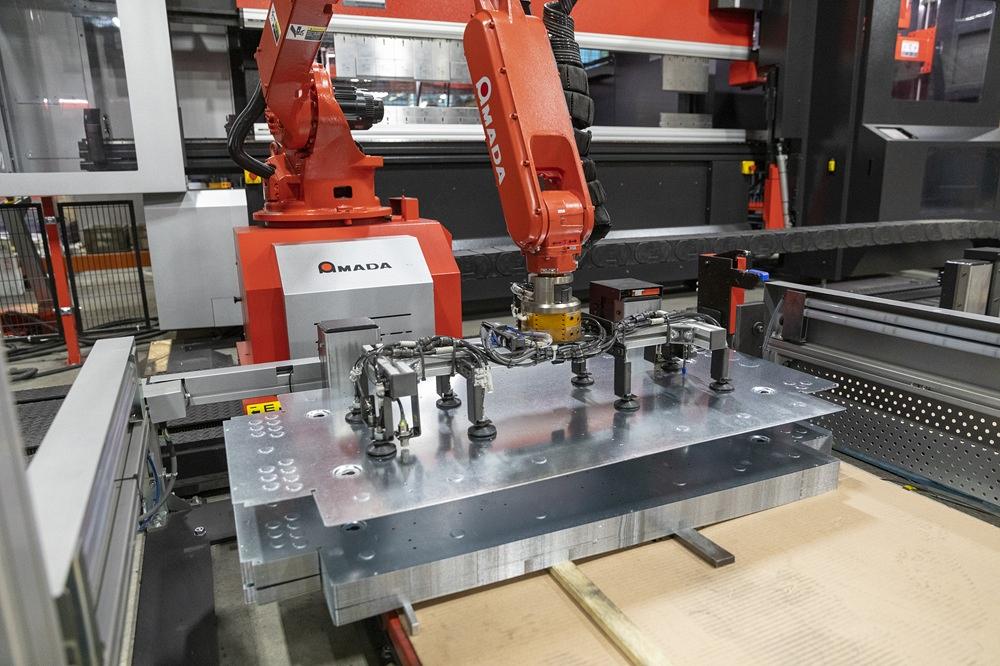
Blanks destined for robotic bending cells require particular attention. Short flanges formed on the punch cause stacking complications. Each successive blank shifts one material thickness. This affects robotic gripper positioning. EVS engineers out stacking problems when possible. Internal window flanges form on the press brake instead.
Automated Denesting on the Investment Horizon
EVS Metal plans to invest in punch presses with automated denesting within the next few years. This includes parts picking and stacking capabilities. The technology addresses labor availability challenges. Tedious manual denesting work is increasingly difficult to staff.
Automated denesting requires nest layout adjustments. Part removal sequences must prevent skeleton warping as clamps move increasingly flimsy material. Modern systems handle these issues through optimized removal sequencing.
Combining automated denesting with traditional tower automation offers operational flexibility. Lights-out capability remains intact. Tedious manual steps disappear. The fabricator can scale throughput without proportional labor increases.
Constraint Management Drives Blanking Strategy
Most EVS products follow complex routings beyond blanking and bending. Assembly, powder coating, and purchased component integration add process steps. Downstream operations typically contain the constraint processes.
Blanking cannot afford to starve those constraints. Workers wipe surface oil from punched blanks before bending. This simplifies robotic handling and subsequent finishing operations. The extra step prevents downstream complications.
EVS Metal’s approach demonstrates how turret punching maintains relevance in modern fabrication. Electric servo drives deliver speed. Tool magazines provide flexibility. Automation enables lights-out production. The combination supports high-mix manufacturing at scale.