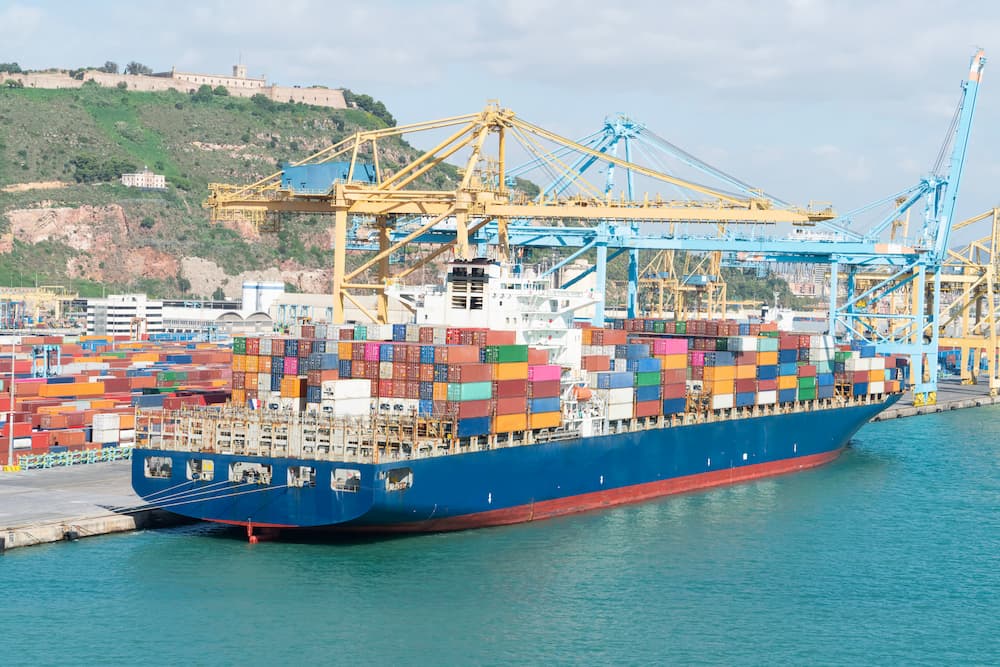
China has entered a new phase of shipbuilding expansion that is expected to add around 200 vessels annually to global production capacity, reinforcing its position as the world’s dominant shipbuilding nation. Analysts say the latest expansion wave, which began in 2024, reflects both strong demand and a strategic push to consolidate China’s market leadership.
According to data from BRS Shipbrokers, China’s total shipbuilding output rose by 12% in 2024 to 47.8 million deadweight tonnes (dwt). The country’s orderbook-to-annual output ratio climbed to a record 5.5, up sharply from 3.8 in 2023 and 3.2 in 2022. Analysts note that most Chinese shipyards are fully booked for the next three to four years, with no available delivery slots before the end of 2028.
China led global shipbuilding orders in 2024 across bulk carriers, tankers and container vessels, with the LNG carrier segment remaining the only area still dominated by South Korea. However, analysts are increasingly questioning how long that dominance will last as Chinese yards expand their technical capabilities.
BRS data shows that China’s top five shipbuilding groups controlled 69% of the country’s total orderbook in 2024, equivalent to 179.9 million dwt. Their combined share of the global orderbook surged to 46.5%, up from 33% a year earlier. At the top stands China State Shipbuilding Corporation (CSSC), which holds 34.2% of China’s orderbook and 23% of the global total. In 2024 alone, CSSC secured new orders amounting to 48.2 million dwt, more than three times the volume booked by South Korea’s largest shipbuilder, HD Hyundai.
Private shipbuilders New Times Shipbuilding and Yangzijiang follow in second and third place domestically, with orderbooks of 24.6 million dwt and 23.4 million dwt, respectively. On a global scale, this places them among the top four shipbuilding groups worldwide. Cosco Shipping Heavy Industry has slipped to fourth place in China, while Hengli Shipbuilding, a relatively new entrant formed after acquiring the former STX Dalian yard, has rapidly risen to become one of the world’s largest shipbuilders with an orderbook of nearly 20 million dwt.
Segment-by-segment analysis highlights China’s growing breadth. Qingdao Beihai leads the dry bulk market by order backlog, New Times dominates tanker construction, and Yangzijiang remains the top builder of container vessels. In LNG carriers, CSSC’s Hudong-Zhonghua continues to lead, but four additional Chinese yards have entered the segment since 2022, signalling a significant expansion of national capabilities.
China is also strengthening its dominance in alternative-fuelled vessels. In 2024, Chinese shipyards secured orders for 447 dual-fuel ships, excluding LNG carriers, accounting for nearly 77% of all such orders globally. By comparison, South Korea and Japan captured 13.4% and 3.4% of global dual-fuel orders, respectively.
The current expansion wave includes the reopening of dormant shipyards, major capacity increases at existing facilities, and new players entering the international market. Analysts have identified at least eight newly opened or reopened yards and multiple large-scale expansion projects already under way.
BRS Shipbrokers cautions that unchecked growth could introduce risks, including potential market instability. Another concern is that China’s rapid expansion may further erode the market shares of Japan and South Korea. However, analysts also note that the growth could ultimately expand global shipbuilding capacity rather than simply redistribute orders.
With geopolitical tensions remaining elevated, analysts say governments are once again viewing shipbuilding as a strategic industry. As a result, major shipbuilding nations are increasingly reluctant to allow yard closures, underscoring the sector’s renewed importance in global trade and industrial policy.