In the high-precision world of sheet metal fabrication, the quality of a part is not solely defined by the accuracy of the cut, but by the perfection of its finish. Hans Weber Maschinenfabrik (WEBER), a family-owned powerhouse founded in 1922 in Kronach, Germany, has spent over a century perfecting the science of “Surface Intelligence.” While many manufacturers view deburring as a secondary necessity, Weber has elevated it to an industrial art form.
Today, Weber is globally recognized as the definitive leader in automated deburring and surface finishing. Their secret weapon? The Planetary Head (DR) System. By combining high-speed rotation with a secondary orbital motion, Weber has solved the most persistent challenge in metal finishing: achieving absolutely uniform edge rounding on every side of a part, regardless of its orientation on the conveyor belt.
The Weber Heritage: 100 Years of “Made in Germany” Excellence
Weber’s journey from a specialized grinding machine manufacturer for the slate industry to a global leader in metal and plastic technology is a testament to German engineering resilience. Every Weber machine is developed and manufactured at their headquarters in Bavaria, ensuring that the “Made in Germany” seal is not just a label, but a promise of 20+ years of operational life.
The Weber Philosophy:
- Modularity: Weber machines are built on a “Build-to-Order” modular principle. A single machine can be equipped with up to five different processing stations—ranging from heavy grinding rollers to fine planetary brushes.
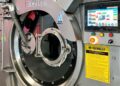
- Ergonomics & Design: The modern PT and TT series are recognized for their clean lines and “i-Touch” controller, proving that heavy industrial machinery can be as intuitive as a smartphone.
- Vertical Integration: From the electrical switch boxes integrated into the machine frames to the proprietary control software, Weber maintains total control over the technology stack.
The DR Planetary Head: The “Double Rotation” Advantage
The crown jewel of Weber’s technology is the DR Planetary Head. Traditional brush systems often struggle with “shadowing”—where one side of a part is rounded more than the other because of the brush’s direction.
How the Planetary System Works:
- Double Rotation: Several rotating cup brushes are arranged in groups. These brushes rotate on their own axes while simultaneously being rotated by a secondary “sun gear” carrier.
- Multi-Directional Impact: This dual motion ensures that the bristles strike the edge of the metal from every possible angle.
- Overlapping Tools: In Weber’s patented design, the tools of adjacent heads overlap, ensuring there are no “dead zones” or gaps during the machining process.
- Uniform Wear: Because of the planetary motion, the brushes wear down evenly across their entire surface, drastically reducing operating costs and maintenance frequency.
CBF Technology: A Perfect Surface Without Chatter Marks
Beyond edge rounding, Weber is a master of surface aesthetics. Their patented CBF (Cross Belt Finishing) technology is a breakthrough for companies requiring high-end decorative finishes.
- The Segmented Beam: CBF uses a segmented grinding beam that presses the abrasive belt against the workpiece with variable pressure.
- Eliminating Chatter: By utilizing a transverse-running internal belt, CBF breaks up the traditional linear grinding pattern, eliminating the “chatter marks” often seen with standard wide-belt sanders.
- Stainless Steel Excellence: For the food and medical industries, where surface roughness ($Ra$) must be strictly controlled, CBF provides a repeatable, mirror-like finish that meets the highest hygiene standards.
The PT and TT Series: Machines for Every Scale
Weber offers a comprehensive range of machines tailored to different production volumes:
The PT Series: The Universal Powerhouse
The Weber PT is the multi-purpose flagship. It effortlessly handles everything from thin 0.3mm sheets to heavy 100mm plates.
- Configuration: Can be equipped with up to 5 stations.
- Applications: Deburring, rounding, descaling, and surface grinding in a single pass.
- Heavy Plate Mastery: For oxy-fuel or plasma-cut plates with heavy slag, the PT can be equipped with a STC Bolt Grinding Beam to “chisel” away the toughest burrs before the planetary brushes take over.
The TTSC Series: Compact Precision
For smaller shops, the TTSC provides Weber’s legendary planetary technology in a space-saving footprint. It is the ideal solution for laser-cut, punched, or nibbled parts where edge quality is the priority over high-tonnage plate processing.
Slag Removal and Descaling: The Heavy-Duty Challenge
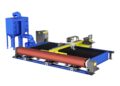
Plasma and flame cutting produce “slag”—the molten metal residue that clings to the bottom of the cut. Removing this manually is time-consuming and dangerous. Weber’s specialized Slag Grinding Units use high-pressure rollers and specialized belts to remove even the most stubborn dross, preparing the part for the subsequent planetary rounding phase.
Industry 4.0: The “i-Touch” and Smart Control
In 2026, a Weber machine is a fully connected asset. Through the i-Touch Controller and Siemens-based architecture, Weber machines integrate seamlessly into the digital factory.
- Adaptive Grinding Pressure: Sensors detect the thickness of the incoming plate and automatically adjust the roller and brush height, preventing crashes and ensuring consistent results on warped material.
- Tool Life Tracking: The machine monitors the wear of the planetary brushes and grinding belts, notifying the operator exactly when a change is needed to maintain quality.
- Remote Support: Weber’s technicians can log into the machine globally to optimize parameters or troubleshoot software, ensuring maximum uptime.
Strategic Advantages: Why Choose Weber?
For a production manager, the “Weber Advantage” is a calculation of Total Cost of Ownership (TCO) and part consistency.
| Feature | Weber Planetary Solution | Standard Brush/Disc Systems |
| Edge Rounding | 360° Uniform (No Shadowing). | Often inconsistent on trailing edges. |
| Tool Wear | Evenly distributed / Long life. | Concentrated wear / Frequent changes. |
| Versatility | Thin foil to 100mm plate. | Usually optimized for one or the other. |
| Surface Quality | CBF Patented (No chatter marks). | Standard linear finish. |
| Maintenance | Lateral pull-out units (Fast change). | Internal access / Slow tool change. |
Sector-Specific Applications
Weber technology is the standard-setter in sectors where the “Touch and Feel” of the metal are critical:
- Automotive: Deburring structural parts and rounding edges to prevent paint peeling and corrosion.
- Food & Medical: Utilizing CBF technology for stainless steel surfaces that must be perfectly smooth to prevent bacterial growth.
- Aerospace: Precision edge breaking on complex aluminum components where “stress risers” must be eliminated.
- Construction Machinery: Heavy plate descaling and deburring for parts that will be powder-coated and subjected to extreme weather.
Sustainability: The Eco-Friendly Finishing
Weber is a leader in Green Grinding.
- Eco-Drive: Their high-efficiency motors reduce electricity consumption by up to 30%.
- Wet Grinding Technology (NLC Series): For materials like titanium or aluminum where dust is explosive, or for parts with heavy oil films, Weber’s wet-grinding systems recycle water through a sophisticated filtration system, minimizing environmental impact.
- Longevity: Weber machines are famously “over-engineered.” A machine that lasts 25 years represents a significantly lower lifecycle carbon footprint than a cheaper machine that must be replaced every 8 years.
Training and the Weber Experience
Weber believes that “Quality is a result of knowledge.”
- The Training Center: At their headquarters in Kronach, Weber provides deep-dive training for operators on how to choose the correct brush grit and belt speed for different alloys.
- Application Testing: Weber invites customers to send their “problem parts” to their laboratory. Engineers will test various planetary configurations to find the absolute best process before the customer commits to a purchase.
The Future: AI-Vision Guided Surface Inspection
By 2027, Weber is set to integrate AI-Vision at the machine exit. A high-speed camera will inspect the surface and edges of every part. If the system detects that the edge radius is decreasing due to brush wear, it will autonomously adjust the planetary head’s pressure to compensate, achieving a truly autonomous “closed-loop” quality control system.
Shaping the Edge of Perfection
Hans Weber Maschinenfabrik remains the undisputed champion of the planetary finishing world. By refusing to compromise on the complexity of the motion and the rigidity of the build, they have provided fabricators with a tool that does more than just remove a burr—it adds value, safety, and aesthetic beauty to every piece of metal it touches.
For the manufacturer who demands 360-degree precision, a chatter-free surface, and the reliability of a century-old German legacy, Weber is the only choice. They don’t just grind metal; they define the standard by which all surfaces are measured.
Master your surfaces with Weber at www.hansweber.de or www.weberamerica.com